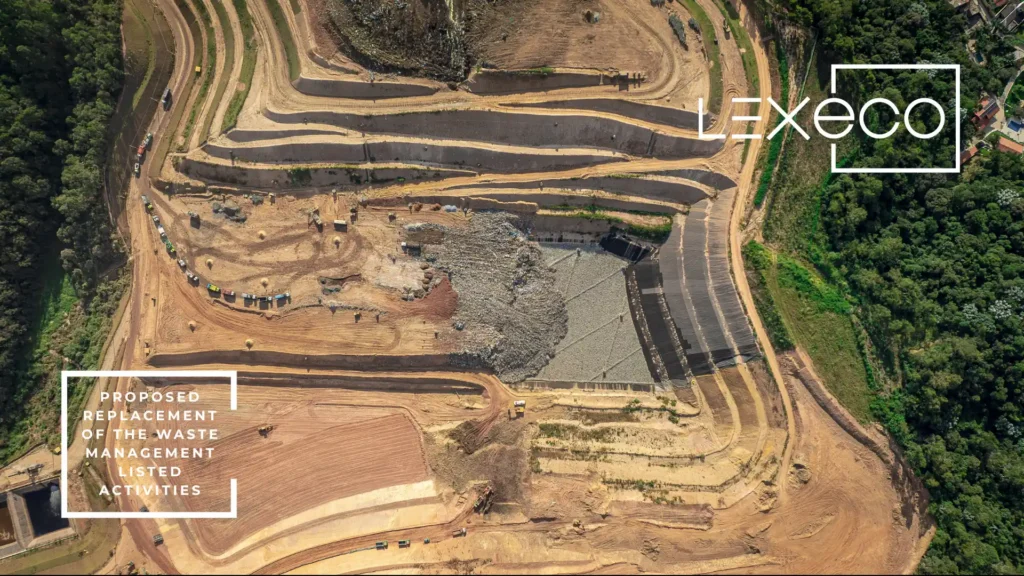
On 12 May 2026, the Minister of Forestry, Fisheries and the Environment published, for public comment, a Draft Notice proposing the repeal and replacement of the list of waste management activities that have, or are likely to have, a detrimental effect on the environment (Draft Notice). Issued under section 19(2), read with sections 72 and 73, of the National Environmental Management: Waste Act 59 of 2008 (NEM:WA), the Draft Notice will replace the 2013 Listed Activities Notice in its entirety. Comments close on 11 July 2026.
The proposed reform is significant. It is not a cosmetic refresh of the 2013 list, and recasts the activity categories, adjusts the thresholds that trigger a Waste Management Licence (WML), redefines key terms and, importantly, repositions a number of activities into a norms-and-standards compliance regime.
What Is Proposed
The Draft Notice retains the three-category structure but redraws the boundaries:
- Category A: General waste, at scale Requires a WML supported by a basic assessment under the EIA Regulations. Captures lagoon storage of general waste, recycling above 10 tons, recovery and treatment above 10 tons per day (excluding organic composting), disposal of inert waste above 25 tons, and disposal of domestic waste in unserviced areas above 0.5 tons per month.
- Category B: Hazardous waste Requires a WML supported by a basic assessment, at materially lower thresholds: lagoon storage, reuse or recycling above 0.5 tons per day, recovery or treatment above 0.5 tons per day, lagoon treatment, and any disposal of hazardous waste to land. Notably, the Draft Notice applies a basic assessment pathway to Category B.
- Category C: Norms-and-standards compliance Does not require a WML. Operators must instead comply with applicable Minister-determined norms and standards covering general-waste storage above 100 m³, hazardous-waste storage above 80 m³, waste-tyre storage above 500 m², motor-vehicle scrapping above 500 m², landfill gas extraction, sorting and bailing of general waste, and the composting and treatment of organic waste.
Definitional Shifts That Matter Environmentally
Four definitional changes carry particular weight:
- “Construction” is narrowed to exclude modifications, expansions or upgrades that do not change the nature of the activity or the range of outputs.
- “Expansion” captures any change increasing capacity or volume of waste handled.
- “Temporary storage” is limited to once-off storage not exceeding 90 days.
- “Co-processing” is defined as the use of alternative fuels or raw material processes for energy or resource recovery in substitution of conventional inputs.
These definitions will determine whether an operational change at an existing facility triggers a fresh licensing process, and they create welcome environmental space for legitimate co-processing pathways.
Environmental Implications For Operators
The Draft Notice will reshape the environmental management programmes of affected operators in three principal ways:
- Category C obligations: Operators newly captured under Category C should not read “no WML” as “no environmental obligation.” Compliance with norms and standards is an ongoing operational discipline requiring documented procedures, monitoring against quantitative limits, and records available for inspection.
- Hazardous waste thresholds: Operators handling hazardous waste must take the lower Category B thresholds seriously. These reflect the disproportionate environmental risk per ton, including leachate, exposure pathways, and persistent ecological impacts. Controls should match the risk, not just the licence pathway.
- Circular economy opportunities: The new framework opens regulatory space for recycling, recovery and co-processing at clearer thresholds, routing beneficial activities away from full impact-reporting pathways. Investment in beneficiation, refuse-derived fuel, organic waste treatment or co-processing should be re-tested under the proposed categorisation.
Practical Environmental Actions
With the 11 July 2026 comment deadline in view, environmental teams should focus on:
- Mapping operations against the new categorisation, identifying activities that move category, change threshold or shift to a norms-and-standards regime.
- Stress-testing waste data, since accurate tonnages, capacities and footprints now drive categorisation.
- Reviewing environmental controls against actual risk, particularly for hazardous waste.
- Building a norms-and-standards compliance programme for Category C activities, including SOPs, monitoring records and incident registers.
- Engaging meaningfully with the public comment process, where categorisation, threshold or definitional issues misrepresent the underlying environmental risk of a sector or activity.
Conclusion
The Draft Notice is, on balance, an environmentally constructive recalibration of South Africa’s waste regulatory architecture. It tightens the regime around hazardous waste, opens regulatory space for beneficial recovery and recycling, and creates a continuous-compliance pathway for lower-risk activities. The environmental gain, however, depends on operators treating the new framework as a programme of environmental management — not as a relabelling of existing compliance documents.
How LexEco Can Assist
LexEco supports waste, mining, manufacturing and infrastructure clients to translate the Draft Notice into practical, environmentally credible programmes. Our team assists with regulatory mapping against the new categories and thresholds; the preparation of submissions during the 60-day comment period; the design of monitoring, recordkeeping and adaptive management systems for norms-and-standards compliance; and the environmental design of facilities to match the actual risk profile of the waste streams they handle. Early engagement during the consultation window offers the best opportunity to shape both the final Notice and an operator’s environmental position under it.