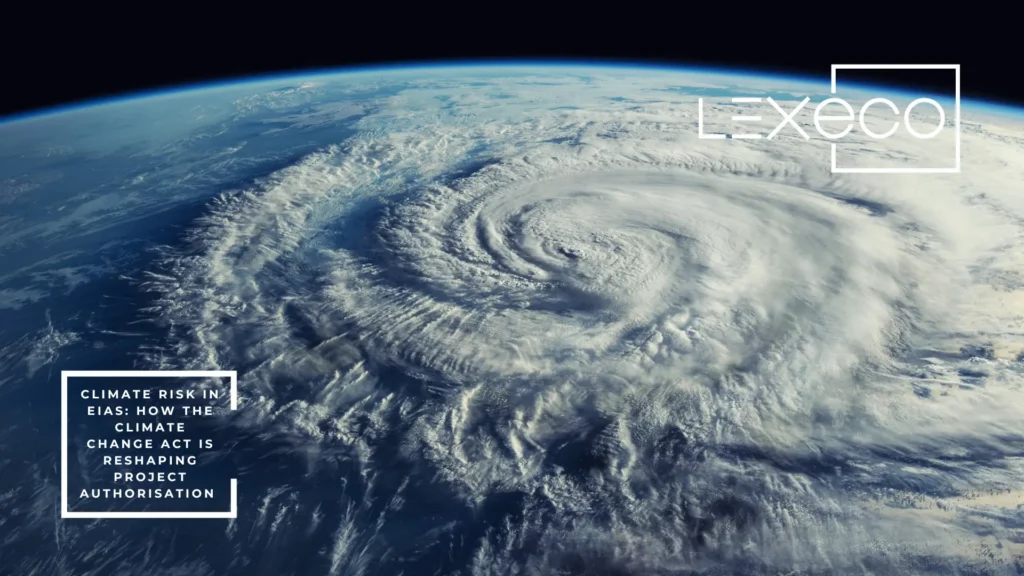
With the phased implementation of the Climate Change Act 22 of 2024 (CCA), which came into effect on 17 March 2025, climate considerations have moved from the margins of the environmental authorisation process to its centre. Sectoral Emissions Targets, carbon budgets for designated greenhouse gas emitters and the duty to prepare and implement greenhouse gas mitigation plans together establish a framework that environmental impact assessments (EIAs) can no longer treat as background context.
In practical terms, climate risk is now a substantive scope item in any meaningful EIA prepared under section 24 of the National Environmental Management Act 107 of 1998 (NEMA). For proponents in mining, energy, heavy industry and infrastructure, the consequence is real: project design, specialist studies, alternatives analysis and mitigation commitments are all being reshaped by the new climate architecture.
Why Climate Matters In An EIA
Climate risk in an EIA has two faces:
- Mitigation risk concerns the project’s contribution to greenhouse gas emissions, direct (Scope 1), purchased energy (Scope 2) and value chain (Scope 3), and the regulatory, financial and reputational exposure that follows.
- Adaptation risk concerns the project’s exposure to climate change itself: shifting rainfall patterns, more intense storm events, rising temperatures, drought, sea level rise and wildfire frequency. Both feature, increasingly, in the environmental performance of long‑lived assets in South Africa.
Section 24 of NEMA already required cumulative impact and an evaluation of risk over the life of the activity. The CCA gives that requirement a clearer regulatory anchor and a measurable benchmark: a project must now be assessed against South Africa’s sectoral and national emissions trajectory, not against itself.
The CCA And Its Regulatory Hooks
Four CCA mechanisms have direct bearing on the EIA process:
- Sectoral Emissions Targets (SETs) – translate the national emissions trajectory into ceiling targets for emitting sectors (energy, transport, industry, mining, agriculture, forestry and waste). Sector‑level targets create a cumulative impact benchmark against which new projects can be assessed.
- Carbon budgets – allocate a finite quantum of permitted emissions over a defined period. For affected proponents, the carbon budget effectively prices the climate footprint of new or expanded activities.
- Greenhouse gas mitigation plans – require designated emitters to set out, in writing, how they will operate within their allocated budget, establishing a documented mitigation pathway that the EIA must align with.
- National and provincial adaptation obligations – require relevant organs of state to plan for climate impacts and, in turn, shape the climate‑resilience expectations applied to projects that depend on water, land and infrastructure.
Read together, these mechanisms convert climate change from a soft consideration into a structured framework within which authorisations are now granted, conditioned and, if a project is misaligned, refused.
What Climate Assessment Now Looks Like In An EIA
A credible climate assessment is no longer a paragraph at the back of the impact report. It is a specialist study, with quantitative outputs, that runs alongside the air quality, water and biodiversity assessments. At minimum, environmental practitioners should expect a climate chapter to address:
- Mitigation side – a project‑specific greenhouse gas inventory across Scopes 1, 2 and 3, calculated using a recognised protocol; a comparison of the project’s emissions footprint against the relevant SET and (where applicable) the proponent’s carbon budget; a mitigation hierarchy applied to GHGs (avoid, reduce, replace, offset), with realistic abatement options costed; and the residual emissions profile after mitigation, expressed as both an annual figure and a lifetime total.
- Adaptation side – a downscaled climate projection covering the operational life of the asset; an exposure and sensitivity assessment for key project components (water supply, tailings infrastructure, drainage, foundations, transport routes); a vulnerability ranking; and a set of design or operational adaptation measures with clear triggers for review.
Implications For Proponents
- Alternatives analysis is being re‑weighted. Site, technology and feedstock alternatives that meaningfully reduce the emissions or vulnerability profile of a project will, increasingly, be expected to be carried into the scoping report and the impact assessment phase, not screened out at concept.
- Authorisation conditions are evolving. Environmental authorisations are starting to include emissions intensity benchmarks, periodic re‑assessment triggers and adaptive management commitments tied to monitoring data. Operators should anticipate conditions that travel with the project for the entirety of its life.
- Bankability and stranded asset risk now sit alongside regulatory risk. Lenders applying the Equator Principles, IFC Performance Standard 3 and TCFD‑aligned disclosures will require essentially the same climate assessment that the EIA now demands. A weak climate chapter is increasingly a weak financing case.
Practical Environmental Actions
Proponents preparing new applications, or in the middle of existing processes, should focus environmental teams on:
- Scoping the climate chapter early, not as a late addition. The climate study should inform the alternatives analysis, not be retrofitted to the chosen option.
- Quantifying the GHG footprint across Scopes 1, 2 and 3 using a recognised protocol, and benchmarking against the applicable SET and any allocated carbon budget.
- Applying a mitigation hierarchy to emissions, with realistic abatement and substitution options costed and ranked, not a generic offsets commitment.
- Running a downscaled climate projection over the operating life of the asset and stress‑testing the design against it (water supply, drainage, tailings stability, transport, energy reliability).
- Building adaptive management into authorisation commitments, with monitoring indicators, review triggers and pathways for design adjustment if observed climate trends diverge from the projection used at assessment.
Conclusion
The Climate Change Act has not displaced NEMA. It has, instead, given the section 24 process the structure and benchmarks it has long needed to take climate seriously. For environmentally responsible proponents, the practical consequence is that climate assessment must now sit at the centre of an EIA, on equal footing with the air, water and biodiversity studies that have anchored the discipline for two decades.
Treated as a compliance afterthought, the new framework will generate cost and delay. Treated as an integrated part of project design and environmental management, it can deliver projects that are not only authorisable today, but resilient and financeable over the decades they will operate.
How LexEco Can Assist
LexEco supports mining, energy, industrial and infrastructure clients to embed climate risk into the environmental authorisation process.
Our team assists with the design and integration of climate chapters in scoping and impact reports; project‑level GHG inventories across Scopes 1, 2 and 3; benchmarking against Sectoral Emissions Targets and allocated carbon budgets; downscaled climate projection and adaptation studies for long‑lived assets; alignment with TCFD, IFC Performance Standard 3 and Equator Principles requirements; and the negotiation of climate‑related authorisation conditions and adaptive management commitments.
Early engagement, particularly at the alternatives and scoping stage, materially improves both the environmental and the commercial outcome of an application.