Overview
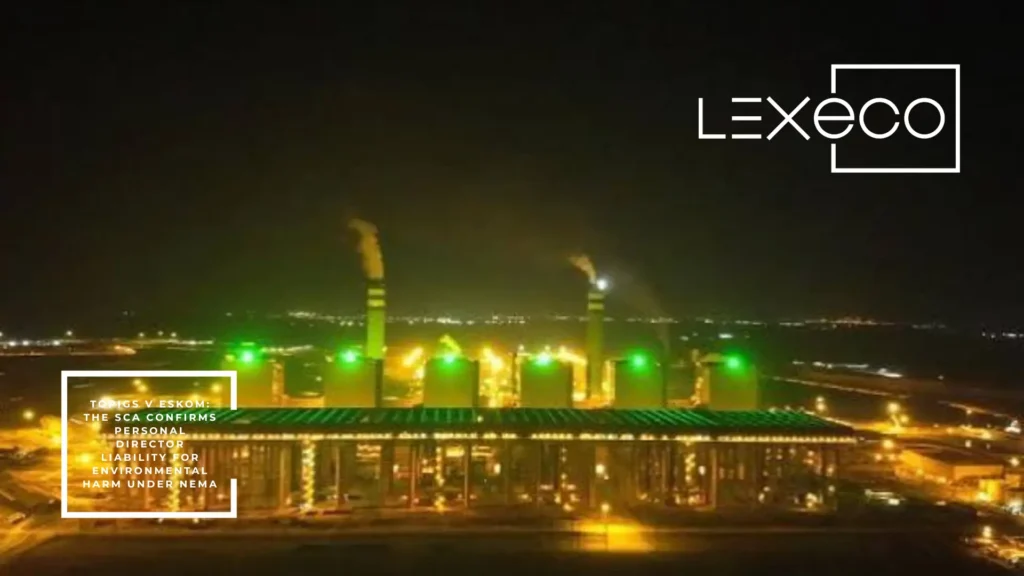
On 14 August 2026, the Supreme Court of Appeal (SCA) handed down judgment in Topigs Norsvin (Pty) Ltd v Eskom Holdings SOC Ltd and Others ((117/2025) [2026] ZASCA 108), overturning a 2024 High Court dismissal and finding that Eskom Holdings SOC Ltd, together with a number of its directors and its entire current board, had for years failed to prevent and rectify water pollution flowing from the Kusile Power Station into downstream water resources used by neighbouring farms in Mpumalanga.
The Court declared that Eskom and its directors were under a legal duty to ensure downstream water quality complied with Kusile’s 2008 environmental authorisation, its 2014 environmental management programme, its 2015 integrated environmental authorisation, the National Environmental Management: Waste Act 59 of 2008 (NEMWA) and the conditions of five Water Use Licences issued under the National Water Act 36 of 1998 (NWA). It found their failure to take reasonable measures to minimise and rectify the pollution unlawful and unconstitutional, in breach of the section 24 environmental right, and ordered detailed mandamus relief: a sworn action plan within 30 days and a sworn compliance report within 60 days, both to be filed personally by Eskom and by the named individual respondents.
For environmental practitioners and company boards generally, the judgment’s most significant contribution is its confirmation, at Supreme Court of Appeal level, that directors of a company can be held personally, jointly and severally liable for environmental harm caused by the company they serve, and that this liability attaches to the office of director as such, not merely to those who were personally at fault.
Background
Topigs Norsvin SA (Pty) Ltd, a swine genetics producer, operates on a farm adjacent to Kusile, downstream of tributaries of the Wilge River. Topigs alleged that pollution from Kusile’s operations had, for years, contaminated the water resources on which its farming operations depended. It cited Eskom, a number of individuals in their capacities as Eskom directors, three senior Eskom employees responsible for environmental matters, the responsible Ministers and Directors-General for water and environmental affairs, the Minister of Mineral Resources and Energy, and the National Energy Regulator of South Africa (NERSA).
The High Court dismissed the application in 2024, holding that Topigs had not exhausted an alternative remedy under section 28(12) of the National Environmental Management Act 107 of 1998 (NEMA) and that granting relief would offend the principle of subsidiarity. It also found the senior Eskom employees misjoined. The SCA overturned the dismissal on the merits.
The Precedent On Director Liability
Directors of a company (and members of a close corporation) are addressed specifically in section 24N(8) of NEMA, which the Court held means that, “notwithstanding the provisions of the Companies Act 71 of 2008, the directors of a company and members of a close corporation can be held jointly and severally liable for any environmental harm caused by the entity they represent, whether intentionally or unintentionally, including damage, degradation, or pollution“. The Court explained the rationale plainly: directors “should be held accountable, as they are the controlling mind of a company and have the duty and power to oversee and control it“.
Several features of this finding are worth drawing out –
- Section 24N(8) displaces ordinary limited liability: the Court was explicit that this liability applies notwithstanding the Companies Act’s general principle that a company is a separate legal person distinct from its directors and shareholders. Environmental harm caused by the company can therefore expose its directors personally, without the need to pierce the corporate veil through the ordinary common law route;
- Liability does not depend on personal fault or intention: the provision applies to environmental harm caused by the entity “whether intentionally or unintentionally.” The rationale is oversight and control, not individual wrongdoing, making this a form of liability tied to the office of director itself rather than to proof that a particular director acted improperly;and
- The current sitting board was held jointly and severally liable alongside Eskom for prospective compliance: all twelve members of Eskom’s current board were ordered, together with Eskom, to file a sworn action plan within 30 days and a sworn compliance report within 60 days. This confirms that directors inherit exposure for the company’s ongoing environmental non-compliance from the moment they take office, regardless of whether they held office when the underlying pollution began.
Broader Significance Of The Judgment
Beyond the director liability finding, the judgment sets out several points of wider application to environmental compliance and enforcement –
- Reliance on the section 24 constitutional right does not offend subsidiarity: the Court held that Topigs’ case was properly grounded in NEMA and related environmental legislation, with section 24 invoked in support, and that this did not improperly bypass the legislation enacted to give effect to the right;
- Section 28(12) of NEMA is not an exclusive remedy: the Court rejected the High Court’s finding that Topigs was barred from relief for failing to invoke NEMA’s own compliance directive mechanism first, confirming that affected parties may proceed directly to court for interdictory and declaratory relief; and
- Regulatory enforcement discretion is now judicially constrained: the Directors-General of the Departments of Water and Sanitation and of Forestry, Fisheries and the Environment were declared to have acted unlawfully by failing adequately to enforce compliance, and were ordered to assess, within 75 days, whether enforcement directives, compliance notices or remedial measures should issue under section 28 of NEMA and sections 19 and 53 of the NWA, and are barred from declining to act on the basis that enforcement is discretionary once non-compliance is established.
Implications For Boards And Environmental Compliance
The judgment has immediate, practical implications for the directors and close corporation members of any entity holding an environmental authorisation, waste licence or water use licence –
- Personal, joint and several liability for environmental harm is now a live, SCA-endorsed litigation risk, not a theoretical one: directors of any company or members of any close corporation whose operations breach an environmental authorisation, EMPr, waste licence or water use licence face direct personal exposure under section 24N(8), independent of the company’s own liability;
- Incoming and current directors inherit exposure immediately on taking office: board members should treat environmental compliance due diligence as a standard part of accepting or continuing a directorship, rather than assuming that non-compliance predating their appointment is someone else’s problem;
- Directors’ and officers’ insurance and indemnification arrangements should be reviewed specifically against this exposure: given that ordinary corporate veil protections under the Companies Act do not shield directors from section 24N(8) liability, boards should confirm whether existing D&O cover responds to statutory environmental liability of this kind, and on what terms;
- Environmental authorisation compliance should sit as a standing board-level oversight item: given the “controlling mind” rationale underpinning the provision, delegating environmental compliance entirely to operational management without board-level visibility and oversight increases, rather than reduces, director exposure; and
- Litigants, not only regulators, can obtain personal mandamus relief against directors: the order requiring Eskom’s current board to personally file sworn action plans and compliance reports shows that private parties affected by environmental harm can secure remedies that reach individual directors directly, a significant escalation beyond a declaratory finding against the company alone.
Practical Steps
Boards of companies and close corporations holding environmental, waste or water use authorisations should consider –
- commissioning an immediate audit of compliance status against all environmental authorisation, EMPr, waste licence and water use licence conditions;
- requiring specific board-level briefings on any known or unresolved environmental non-compliance, given that personal exposure under section 24N(8) attaches on assuming office;
- reviewing D&O insurance policies for coverage of, or exclusions relating to, statutory environmental liability of directors and close corporation members;
- formalising environmental compliance reporting lines to the board, so that any director called upon to file a sworn compliance plan or report can rely on credible, well-documented internal systems; and
- engaging proactively with the DWS and DFFE on any known non-compliance, given that regulators can no longer treat enforcement as a matter of unconstrained discretion once non-compliance is established.
Conclusion
Topigs v Eskom is the clearest Supreme Court of Appeal confirmation to date that section 24N(8) of NEMA means what it says: directors of a company, and members of a close corporation, can be held personally, jointly and severally liable for environmental harm caused by the entity they govern, whether or not they were personally at fault, simply by virtue of their duty and power to oversee and control it. That liability sits alongside, and does not depend on proving, a breach by the company itself, and it can result in directors being personally ordered to file sworn compliance plans under a court’s supervision. Boards across every sector holding an environmental authorisation should treat this judgment as confirmation that environmental compliance is now, unambiguously, a personal governance responsibility.
How LexEco Can Assist
LexEco advises boards, directors and close corporation members on environmental compliance governance and personal liability exposure, including:
- advising directors and boards on the scope of personal liability under section 24N(8) of NEMA and the governance response required;
- conducting environmental compliance audits for incoming directors and close corporation members, and for existing boards seeking to assess current exposure;
- reviewing directors’ and officers’ insurance and indemnification arrangements for adequacy against statutory environmental liability;
- representing directors and companies in NEMA and National Water Act enforcement proceedings and related civil litigation; and
- structuring board-level environmental oversight and reporting frameworks that reduce both compliance risk and personal director exposure.
With personal director liability for environmental harm now judicially confirmed and enforced at Supreme Court of Appeal level, boards should treat environmental compliance as an immediate governance priority rather than a delegated operational matter. Contact LexEco to discuss your board’s environmental compliance and liability position.